Reroute plans GO Transit trips with live line status, and connects them to TTC, YRT, and MiWay in the same itinerary, so a trip that starts at a GO station doesn't need a second app once you get off the train.
- 7 GO rail corridors
- UP Express
- Live line status
Every GO rail corridor and GO bus route
All seven GO rail corridors, Lakeshore West, Lakeshore East, Milton, Kitchener, Barrie, Richmond Hill, and Stouffville, are in Reroute's routing engine alongside the full GO bus network, so a trip can mix a GO train with a GO bus leg where that's genuinely the fastest way there.
- Lakeshore WestUnion to West Harbour / Niagara Falls
- Lakeshore EastUnion to Oshawa
- MiltonUnion to Milton
- KitchenerUnion to Kitchener
- BarrieUnion to Allandale Waterfront
- Richmond HillUnion to Bloomington
- StouffvilleUnion to Lincolnville
UP Express to Pearson, in the same search
UP Express between Union Station and Toronto Pearson is planned the same way as any other leg, ranked against GO rail, TTC, and driving, so you can see whether the express train, a GO train connection, or driving to the airport actually saves the most time for your specific trip.
See the connection to TTC, YRT, and MiWay
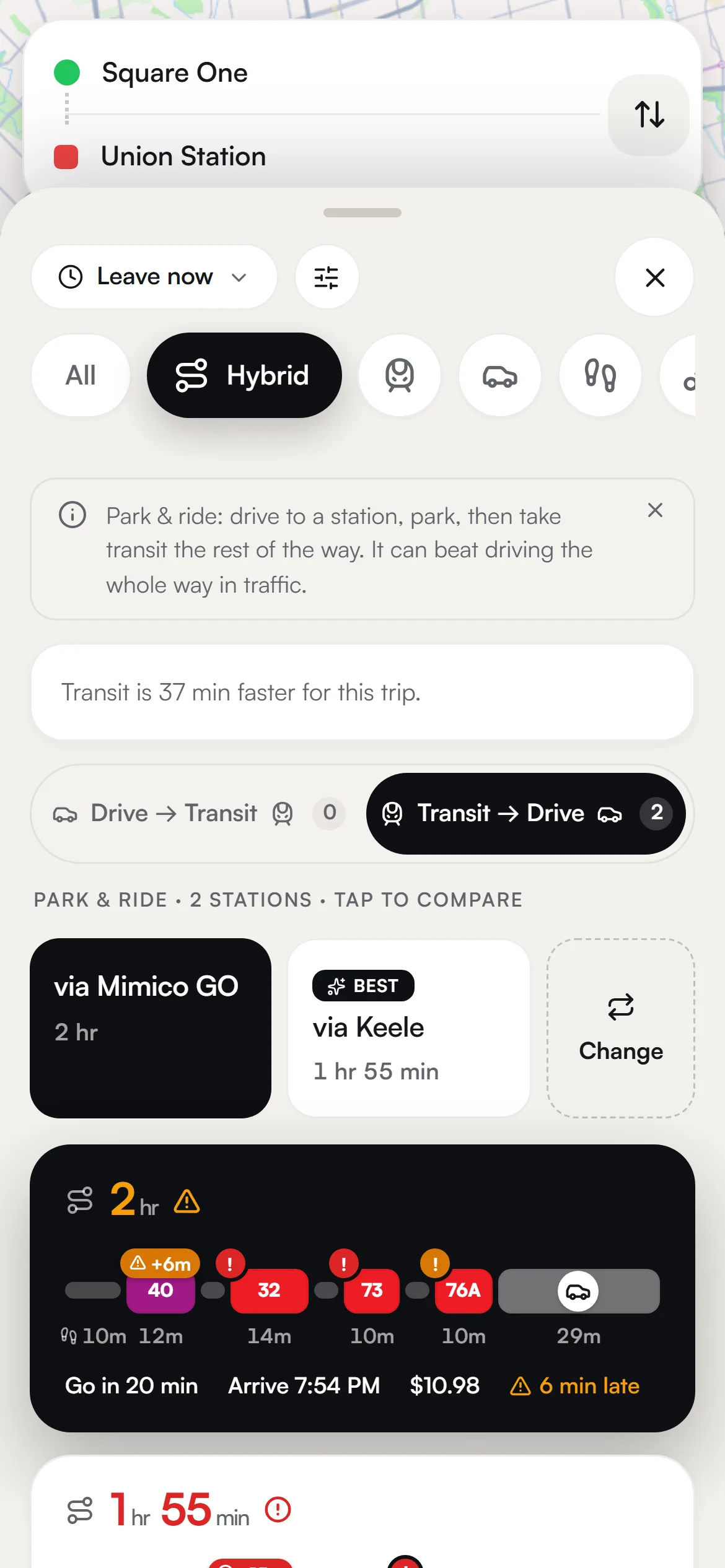
Most GO trips don't start or end at a GO station. Reroute plans the local leg, TTC subway or streetcar downtown, York Region Transit in the north, MiWay in Mississauga, as part of the same itinerary, with the connection at the GO station already worked out. The same logic covers driving to the station: a park and ride leg is ranked against the all-transit and all-driving options rather than assumed. For the full agency list, see Toronto transit, every agency.


Live GO status, not just the schedule
Line status is pulled from Metrolinx's own live feeds rather than a static timetable, so delays and disruptions on your corridor show up before you leave. That said, GO Transit legs don't carry the same predictive delay-risk model as the TTC (see the TTC route planner for how that model works): for GO, Reroute shows you the current line status honestly rather than a forecast it hasn't trained a model to make.
Browse GO lines & stations
Every GO rail corridor and station has its own page: stops served, schedule, first & last train, and connections to local transit.
Stations
- Acton
- Agincourt
- Ajax
- Aldershot
- Allandale Waterfront
- Appleby
- Aurora
- Barrie South
- Bloomington
- Bloor
- Bradford
- Bramalea
- Brampton Innovation District
- Bronte
- Burlington
- Centennial
- Clarkson
- Confederation
- Cooksville
- Danforth
- Dixie
- Downsview Park
- Durham College Oshawa
- East Gwillimbury
- Eglinton
- Erindale
- Etobicoke North
- Exhibition
- Georgetown
- Gormley
- Guelph Central
- Guildwood
- Hamilton GO Centre
- Kennedy
- King City
- Kipling
- Kitchener
- Langstaff
- Lisgar
- Long Branch
- Malton
- Maple
- Markham
- Meadowvale
- Milliken
- Milton
- Mimico
- Mount Dennis
- Mount Joy
- Mount Pleasant
- Newmarket
- Niagara Falls
- Oakville
- Old Cummer
- Old Elm
- Oriole
- Pickering
- Port Credit
- Richmond Hill
- Rouge Hill
- Rutherford
- Scarborough
- St. Catharines
- Stouffville
- Stratford
- Streetsville
- Union
- Unionville
- West Harbour
- Weston
- Whitby